Foster Collaboration
Create a synergistic space for university researchers and industry leaders to share empirical data and case studies.
Track Chair: Dr. AMIT KUMAR, BioAxis DNA Research Centre (P) Ltd, India
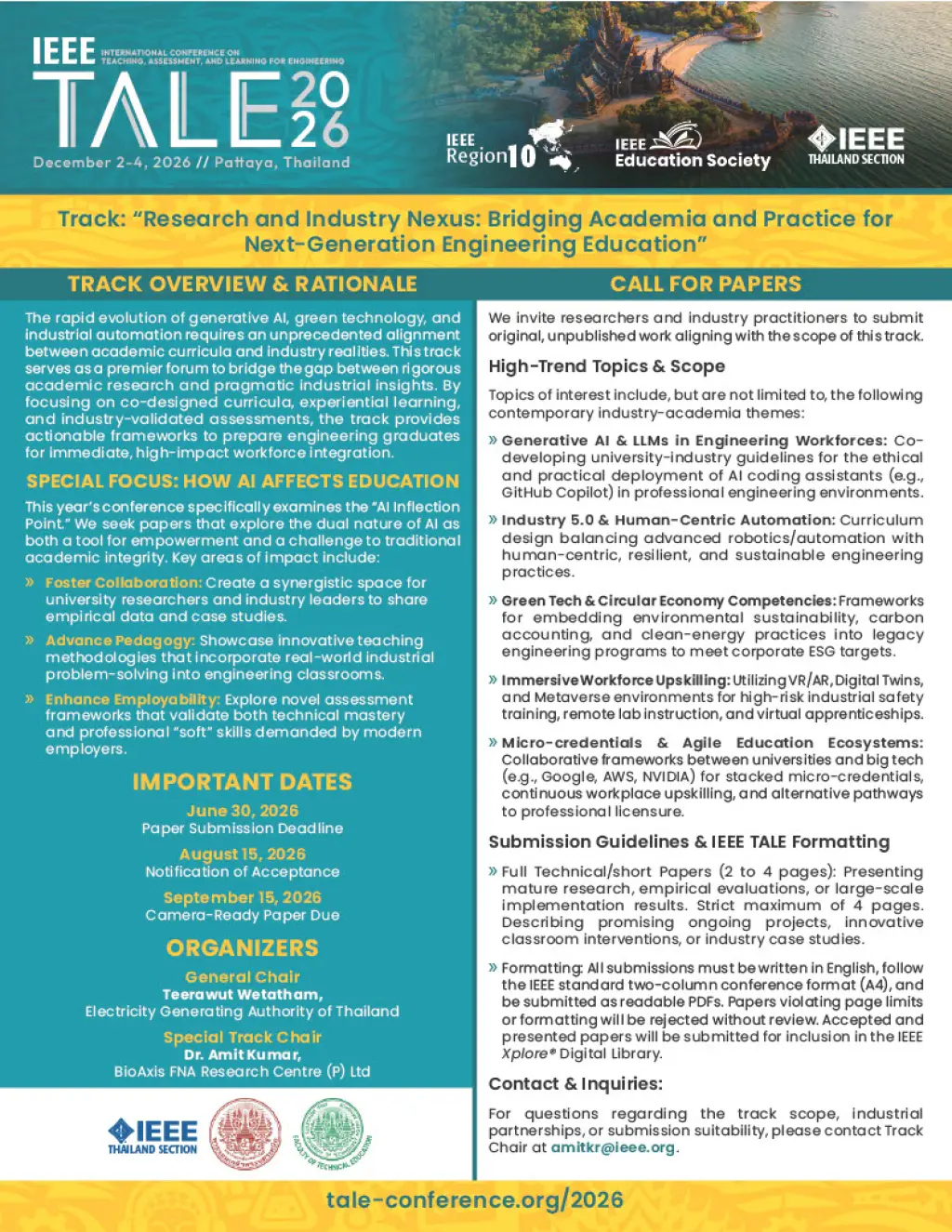
The rapid evolution of generative AI, green technology, and industrial automation requires an unprecedented alignment between academic curricula and industry realities. This track serves as a premier forum to bridge the gap between rigorous academic research and pragmatic industrial insights. By focusing on co-designed curricula, experiential learning, and industry-validated assessments, the track provides actionable frameworks to prepare engineering graduates for immediate, high-impact workforce integration.
Create a synergistic space for university researchers and industry leaders to share empirical data and case studies.
Showcase innovative teaching methodologies that incorporate real-world industrial problem-solving into engineering classrooms.
Explore novel assessment frameworks that validate both technical mastery and professional & skills demanded by modern employers.
We invite researchers and industry practitioners to submit original, unpublished work aligning with the scope of this track.
Topics of interest include, but are not limited to, the following contemporary industry-academia themes:
Co-developing university-industry guidelines for the ethical and practical deployment of AI coding assistants (e.g., GitHub Copilot) in professional engineering environments.
Curriculum design balancing advanced robotics/automation with human-centric, resilient, and sustainable engineering practices.
Frameworks for embedding environmental sustainability, carbon accounting, and clean-energy practices into legacy engineering programs to meet corporate ESG targets.
Utilizing VR/AR, Digital Twins, and Metaverse environments for high-risk industrial safety training, remote lab instruction, and
virtual apprenticeships.
Collaborative frameworks between universities and big tech (e.g., Google, AWS, NVIDIA) for stacked micro-credentials, continuous workplace upskilling, and alternative pathways to professional licensure.
Full Technical/short Papers (2 to 4 pages): Presenting mature research, empirical evaluations, or large-scale implementation results. Strict maximum of 4 pages. Describing promising ongoing projects, innovative classroom interventions, or industry case studies.
Formatting: All submissions must be written in English, follow the IEEE standard two-column conference format (A4), and be submitted as readable PDFs. Papers violating page limits or formatting will be rejected without review. Accepted and presented papers will be submitted for inclusion in the IEEE Xplore Digital Library.
For questions regarding the track scope, industrial partnerships, or submission suitability, please contact Track Chair at [email protected].