Generative AI and LLMs:
Impact of AI on curriculum design, personalized tutoring, and automated feedback.
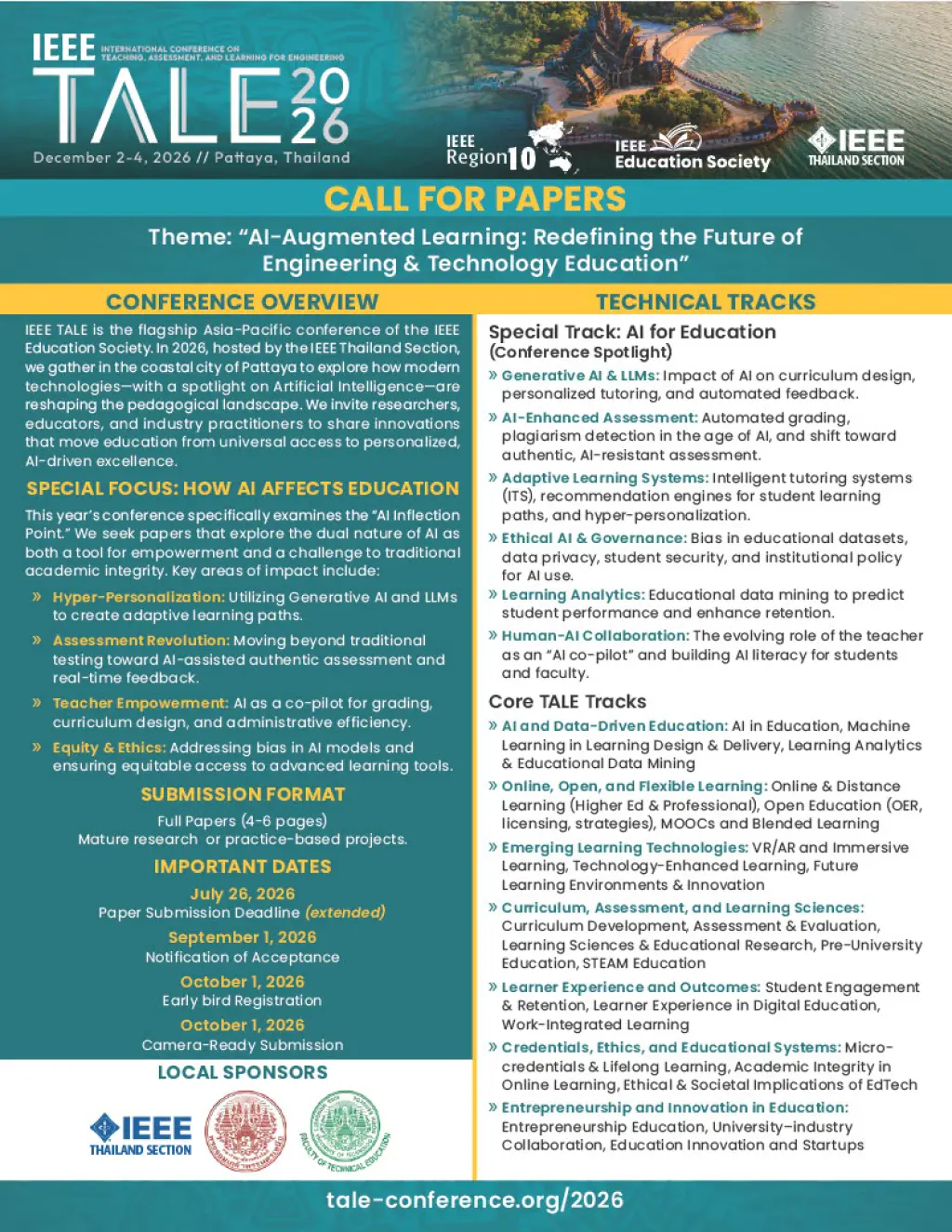
A call for papers invites researchers to submit their work to IEEE TALE 2026 for presentation or publication, outlining topics, and deadlines.
IEEE TALE is the flagship Asia-Pacific conference of the IEEE Education Society. In 2026, hosted by the IEEE Thailand Section, we gather in the coastal city of Pattaya to explore how modern technologies—with a spotlight on Artificial Intelligence—are reshaping the pedagogical landscape. We invite researchers, educators, and industry practitioners to share innovations that move education from universal access to personalized, AI-driven excellence.
In 2026, IEEE TALE returns as a leading international forum dedicated to advancing innovation and excellence in engineering, technology, and computing education across the Asia-Pacific region and beyond.
IEEE TALE 2026 brings together academic, industry, and government professionals to explore emerging trends, research, and practical applications related to technology-enhanced learning, engineering education, artificial intelligence in education, digital transformation, and future learning environments. The conference provides an inclusive platform for collaboration, networking, and the exchange of ideas focused on improving teaching, learning, and educational accessibility in an increasingly connected world.
Recognized as a premier international conference in the field of educational innovation and technology-enhanced learning, IEEE TALE fosters interdisciplinary dialogue among educators, researchers, instructional designers, policymakers, and industry leaders. The conference aims to promote impactful research, share innovative practices, and encourage global partnerships that contribute to the future of education and workforce development.
Special Focus
This year’s conference specifically examines the “AI Inflection Point.” We seek papers that explore the dual nature of AI as both a tool for empowerment and a challenge to traditional academic integrity. Key areas of impact include:
Impact of AI on curriculum design, personalized tutoring, and automated feedback.
Automated grading, plagiarism detection in the age of AI, and shift toward authentic, AI-resistant assessment.
Intelligent tutoring systems (ITS), recommendation engines for student learning paths, and hyper-personalization.
Bias in educational datasets, data privacy, student security, and institutional policy for AI use.
Educational data mining to predict student performance and enhance retention.
The evolving role of the teacher as an “AI co-pilot” and building AI literacy for students and faculty.
Special Track: AI for Education
(Conference Spotlight)
Impact of AI on curriculum design, personalized tutoring, and automated feedback.
Automated grading, plagiarism detection in the age of AI, and shift toward authentic, AIresistant assessment.
Intelligent tutoring systems (ITS), recommendation engines for student learning paths, and hyper personalization.
Bias in educational datasets, data privacy, student security, and institutional policy for AI use.
Educational data mining to predict student performance and enhance retention.
The evolving role of the teacher as an “AI co-pilot” and building AI literacy for students and faculty.
Core TALE Tracks
Online & Distance Learning (Higher Ed & Professional)
Open Education
MOOCs and Blended Learning
VR/AR and Immersive Learning
Technology-Enhanced Learning
Future Learning Environments & Innovation
Curriculum Development
Assessment & Evaluation
Learning Sciences & Educational Research
Pre-University Education
STEAM Education
Student Engagement & Retention
Learner Experience in Digital Education
Work-Integrated Learning
Micro-credentials & Lifelong Learning
Academic Integrity in Online Learning
Ethical & Societal Implications of EdTech
Entrepreneurship Education
University-industry Collaboration
Education Innovation and Startups